Rental Yield by Postcode: How to Use Rental Data to Vet a Deal
2026-08-25
Every investor starts the same way: find the property, look up what similar places are advertised at, divide by the price, get a yield. It feels like analysis. It is closer to a guess wearing a suit.
The problem is not the arithmetic. It is that the number you started with — the asking rent on a portal — is the wrong input, and the number you finished with — gross yield — is the wrong output.
Asking Rent Is Not Achieved Rent
Portal listings show what landlords want. In a tight market that is roughly what they get. In a soft one, properties sit for six weeks and then let for £75 a month less than advertised — and that reduction never appears anywhere you can search.
ONS private rental data measures actual rents paid across the whole stock, not just what is currently advertised. It moves more slowly and it is less exciting, but it is describing reality rather than aspiration.
Use both. If the portal says £1,200 and the ONS figure for that postcode district says £1,050, you have not found a bargain — you have found a listing that is optimistic, or a property genuinely better than the local average. Work out which before you underwrite it.
Postcode districts, not full postcodes Rental data is meaningful at district level (M14, LS6, BS7) where there are enough transactions to average. A full postcode covers a handful of addresses — any "average" at that granularity is one or two lettings and tells you very little.
Gross Yield Is the Wrong Output
Gross yield is annual rent divided by purchase price. It ignores the mortgage, the management fee, the insurance, the maintenance, the voids, the service charge and the tax. It is useful for exactly one thing: comparing two properties quickly before you look properly.
Two properties can show an identical 7% gross yield and behave completely differently:
:::stats 7.0% | Gross yield — both properties 5.5% | A net — terrace, no service charge 3.8% | B net — flat, £2,300 charges :::
Same headline number, same rent, same price. Property A returns nearly half as much again. The service charge and ground rent account for the entire gap, and neither appears anywhere in a gross yield calculation.
What Postcode Data Should Actually Change
Your rent assumption — and therefore your whole model. If local data says £1,050 and your appraisal assumed £1,200, every downstream number is wrong: your yield, your cash flow, your stress test, your mortgage affordability.
Your void allowance. Areas with strong tenant demand let in days; others sit for a month between tenancies. Two weeks a year is a reasonable default, but it should be an input you set from local evidence, not a number you inherited from a spreadsheet.
Your stress test. The question is not "does this work at today's rent and today's rate?" It is "does this still work at 1% higher on the mortgage and 5% lower on the rent?" If the answer is no, the deal depends on nothing going wrong.
Whether to look at all. The fastest use of rental data is elimination. If the achievable rent in an area cannot service the debt at a realistic loan-to-value, you have saved yourself a viewing.
The Order to Do It In
- Check the postcode district's rental level against the rent you have been told. Reconcile any gap before going further.
- Convert to gross yield purely as a filter — is this worth ten more minutes?
- Build the real model: mortgage, management, insurance, maintenance, service charge, ground rent, voids.
- Apply tax. Section 24 means a higher-rate taxpayer's after-tax return can be dramatically worse than the pre-tax number suggests.
- Stress it. Rates up, rent down, an extra month empty. What survives?
Most investors do step two and stop. The deals that go wrong are almost always the ones where steps three to five were skipped because step two looked good.
Two Tools, One Workflow
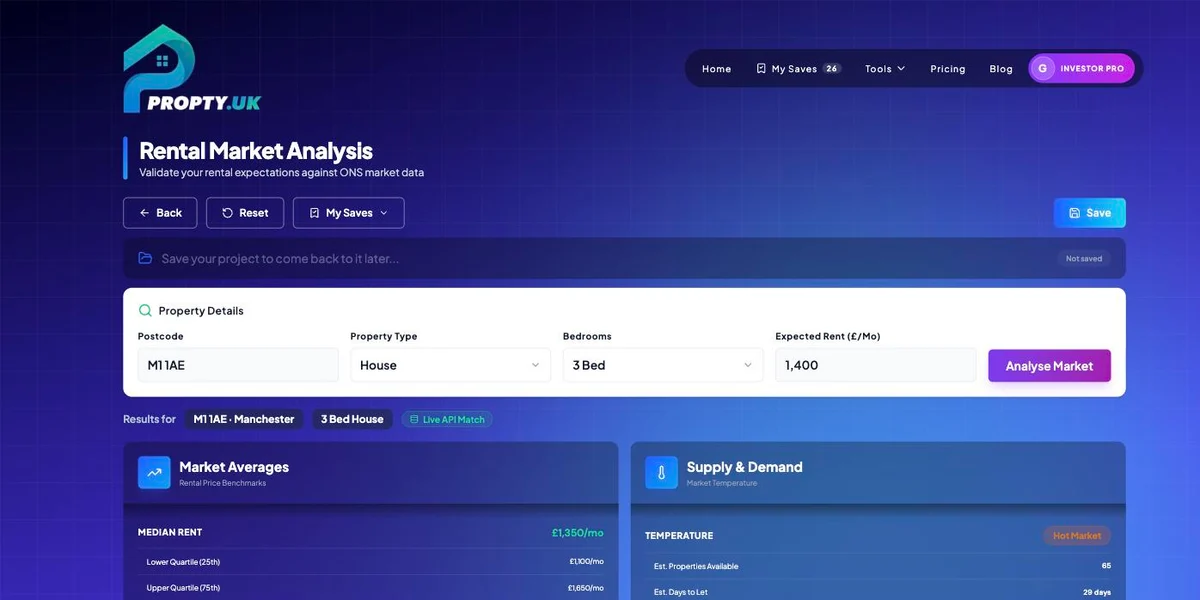
Propty's Rental Market Analysis validates a rent assumption against ONS data by postcode, so step one takes seconds rather than an afternoon of portal archaeology.
:::tool rental-market Check rents by postcode :::
Then feed the validated figure into the Deal Analyser, which handles steps three to five — full cash flow, financing costs, and stress-tested scenarios in one place.
:::tool deal-analyser Run the full deal :::
Postcode data on its own is trivia. Postcode data inside a deal model is a decision.