How Much Tax Will I Pay on Rental Income? UK Landlord Guide 2026
2026-04-02
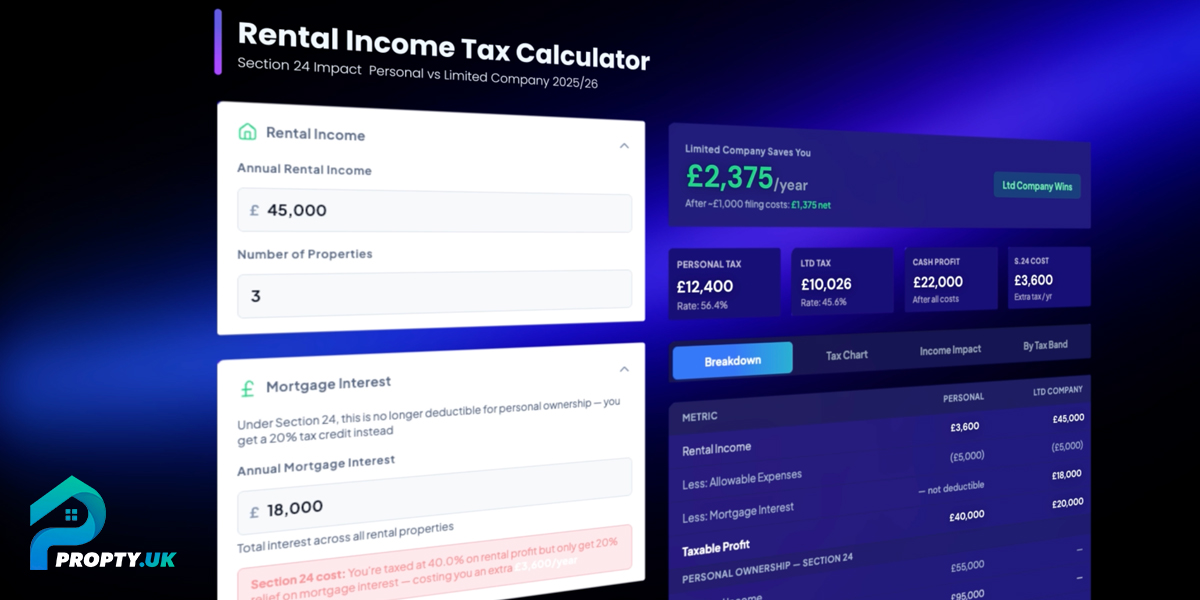
If you're a UK landlord, your rental income is taxed. But exactly how much depends on a stack of variables that catch many investors off guard. Your salary, your mortgage interest, your allowable expenses, and where you sit in the personal allowance taper all feed into the final number. Get one wrong and your "profitable" buy-to-let suddenly isn't.
This guide walks through every layer of UK rental income tax for the 2025/26 tax year, with worked examples at every band so you can see exactly where your money goes.
[!tip] Want the quick answer? If you already know your numbers and want the result, skip the reading and go straight to the calculator.
:::tool rental-tax Calculate Your Rental Tax Now :::
How Rental Income is Taxed in the UK
Rental income doesn't exist in a vacuum. HMRC stacks it on top of your employment income, pension income, and any other earnings. The combined total determines which tax band you're in and how much you pay.
That means a landlord earning £40,000 from their day job and £10,000 net rental profit isn't taxed at 20% on the rental income. The first £10,270 of that rental profit is taxed at basic rate (20%), but anything pushing total income above £50,270 gets taxed at the higher rate (40%).
This stacking effect is one of the most common surprises for new landlords. Your rental income gets taxed at whatever rate sits at the top of your total income pile.
The 2025/26 Tax Bands
:::stats £12,570 | Personal Allowance 20% | Basic Rate (to £50,270) 40% | Higher Rate (to £125,140) 45% | Additional Rate (£125,140+) :::
These bands have been frozen since April 2022 and will stay frozen until at least April 2028. With wages and rents rising, more landlords are being dragged into higher bands each year without actually getting richer. This is fiscal drag, and it's doing more damage to investor returns than most people realise.
[!tip] Your rental profit is what gets taxed Gross rent minus allowable expenses equals your taxable rental profit. The expenses you claim make a significant difference to your final bill. More on that below.
Section 24: The Mortgage Interest Trap
If there's one piece of tax legislation that every landlord needs to understand, it's Section 24 of the Finance Act 2015. It fundamentally changed how mortgage interest is treated for tax purposes, and it hits harder than most investors expect.
What Changed
Before April 2017, landlords could deduct their full mortgage interest payments from rental income before calculating tax. If you earned £12,000 in rent and paid £6,000 in mortgage interest, you were taxed on £6,000 of profit. Simple.
Section 24 phased that out entirely between 2017 and 2020. Now, your mortgage interest is no longer deducted from your income. Instead, you get a basic rate (20%) tax credit applied to your tax bill.
Why This Hurts Higher-Rate Taxpayers
If you're a basic rate taxpayer, the maths works out roughly the same. You were getting 20% relief before, you're getting a 20% credit now.
But if you're a higher rate taxpayer, you've gone from 40% relief to a 20% credit. That's a significant difference. Worse, because the mortgage interest is no longer deducted from your income, it can push your total income into a higher tax band, meaning you pay more tax on everything.
[!warning] Section 24 can create a phantom tax bill Section 24 can push you into a higher tax band even if your actual cash flow is negative. This is the single most misunderstood aspect of UK landlord taxation. You can owe HMRC money on a property that's losing you cash every month.
Worked Example: Section 24 Impact
Take a landlord with a £50,000 salary and a rental property generating £12,000 gross rent with £4,000 allowable expenses and £5,000 mortgage interest.
Before Section 24: Taxable rental profit = £12,000 - £4,000 - £5,000 = £3,000. All taxed at 40% = £1,200 tax.
After Section 24: Taxable rental profit = £12,000 - £4,000 = £8,000 (mortgage interest not deducted). Tax at 40% = £3,200. Then subtract 20% credit on £5,000 interest = £1,000. Net tax = £2,200.
:::stats £1,200 | Tax Before Section 24 £2,200 | Tax After Section 24 £1,000 | Extra Tax Per Year 83% | Effective Tax Increase :::
That's an 83% increase in tax on the same property with the same income. Multiply that across a portfolio with significant mortgage debt and the impact is substantial.
:::video rental-tax :::
:::tool rental-tax See Your Exact Section 24 Impact :::
Allowable Expenses: What Can You Deduct?
Your taxable rental profit is gross rent minus allowable expenses. The more legitimate expenses you claim, the lower your tax bill. HMRC allows a wide range of deductions for landlords:
You can deduct:
- Letting agent fees and management charges
- Buildings and contents insurance
- Maintenance and repairs (not improvements)
- Council tax (if you're paying it, not the tenant)
- Ground rent and service charges
- Utility bills (if you're covering them)
- Legal and accountancy fees for rental business
- Advertising for tenants
- Travel costs for property management
- Replacement of domestic items (like-for-like)
You cannot deduct:
- Capital improvements (new kitchen, extension, loft conversion)
- Mortgage capital repayments (only interest, and only as a credit)
- Your own labour costs
- Personal use portion of any shared expense
The £1,000 Property Income Allowance
If your gross rental income is £1,000 or less, it's entirely tax-free under the property income allowance. You don't even need to tell HMRC about it.
If your income is above £1,000, you have a choice: claim the £1,000 allowance instead of actual expenses, or claim actual expenses. You can't do both.
[!tip] Keep every receipt The difference between a £2,000 and £5,000 expenses claim can shift your effective tax rate significantly. Most landlords under-claim because they don't track smaller expenses like mileage, phone calls, and stationery.
The Personal Allowance Taper
This is the stealth tax that catches higher earners off guard. If your total income (salary plus rental profit) exceeds £100,000, your personal allowance starts to disappear. For every £2 you earn above £100,000, you lose £1 of personal allowance.
By the time your income hits £125,140, your personal allowance is completely gone. The effect creates a hidden 60% effective marginal tax rate between £100,000 and £125,140.
:::stats 60% | Effective Rate (£100k-£125k) £12,570 | Allowance Lost £1 per £2 | Taper Rate :::
[!warning] The 60% stealth band If your salary plus rental profit pushes you above £100,000, you lose £1 of personal allowance for every £2 over. Combined with the 40% higher rate, this creates a 60% effective marginal tax rate. Many landlords don't discover this until they get their tax bill.
This is particularly dangerous for landlords with moderate salaries in the £80,000-£95,000 range. Adding rental profit can tip them into the taper zone without them realising.
Worked Examples
Scenario A: Basic Rate Taxpayer
Profile: £35,000 salary, £12,000 gross rent, £3,000 expenses, £4,000 mortgage interest.
| Line Item | Amount |
|---|---|
| Salary | £35,000 |
| Rental profit (before Sec 24) | £9,000 |
| Total taxable income | £44,000 |
| Tax on salary + rental | £6,286 |
| Section 24 credit (20% of £4,000) | -£800 |
| Final income tax | £5,486 |
| Tax on rental income alone | £1,000 |
:::stats £9,000 | Taxable Rental Profit £1,800 | Tax Before Sec 24 Credit -£800 | Sec 24 Credit £1,000 | Net Tax on Rental Income :::
At basic rate, Section 24 barely changes your position. The 20% credit roughly matches what you'd have saved under the old system.
Scenario B: Higher Rate Taxpayer
Profile: £55,000 salary, £18,000 gross rent, £3,000 expenses, £8,000 mortgage interest.
| Line Item | Amount |
|---|---|
| Salary | £55,000 |
| Rental profit (before Sec 24) | £15,000 |
| Total taxable income | £70,000 |
| Tax on salary + rental | £14,486 |
| Section 24 credit (20% of £8,000) | -£1,600 |
| Final income tax | £12,886 |
| Tax on rental income alone | £4,600 |
:::stats £15,000 | Taxable Rental Profit £6,200 | Tax Before Sec 24 Credit -£1,600 | Sec 24 Credit £4,600 | Net Tax on Rental Income :::
At higher rate, Section 24 bites. You're paying 40% tax on income that includes un-deducted mortgage interest, but only getting 20% back as a credit. The effective tax rate on the rental income is over 30%.
Scenario C: The Taper Zone
Profile: £95,000 salary, £15,000 gross rent, £3,000 expenses, £6,000 mortgage interest.
| Line Item | Amount |
|---|---|
| Salary | £95,000 |
| Rental profit (before Sec 24) | £12,000 |
| Total taxable income | £107,000 |
| Personal allowance lost | £3,500 (half of £7,000 over £100k) |
| Effective personal allowance | £9,070 |
| Tax on salary + rental | £31,486 |
| Section 24 credit (20% of £6,000) | -£1,200 |
| Final income tax | £30,286 |
:::stats £107,000 | Total Taxable Income £3,500 | Personal Allowance Lost 60% | Effective Rate in Taper Zone £30,286 | Final Tax Bill :::
The rental profit pushed this landlord £7,000 into the taper zone, costing an extra £3,500 in lost personal allowance. That's on top of the 40% higher rate tax. The effective marginal rate on that slice of rental income is closer to 60%.
:::tool rental-tax Run Your Own Numbers :::
Holiday Lets and Furnished Holiday Lettings
If you own a holiday let, pay attention. The Furnished Holiday Letting (FHL) tax regime was abolished from 6 April 2025. This was a significant change that removed several valuable tax advantages.
What you lost:
- Full mortgage interest deduction (now restricted to 20% credit, same as standard BTL)
- Capital Gains Tax Business Asset Disposal Relief (10% rate on first £1m, gone)
- Capital allowances on furniture and fixtures (replaced by replacement of domestic items relief)
- FHL profits counting as relevant earnings for pension contributions
[!tip] Holiday lets now taxed the same as standard BTL The removal of FHL tax advantages in April 2025 means your holiday let is now taxed identically to a standard buy-to-let. Use the same calculator, apply the same Section 24 rules.
If you were relying on the FHL regime for tax planning, it's worth reviewing your portfolio structure with a property-specialist accountant. Some holiday let owners are reconsidering whether short-term letting still makes sense given the higher compliance costs and loss of tax benefits.
Making Tax Digital for Landlords
From 6 April 2026, landlords with gross rental income above £50,000 must comply with Making Tax Digital for Income Tax. This is happening now.
What it means in practice:
- You must keep digital records of rental income and expenses
- You submit quarterly updates to HMRC (not annual)
- You still file a final declaration (replacing the self-assessment return)
- You need compatible accounting software or bridging software
The threshold drops to £30,000 from April 2027, and £20,000 from April 2028. Eventually, most landlords will be caught by this.
[!note] First deadline approaching The first quarterly update under MTD covers 6 April to 5 July 2026, due by 7 August 2026. No penalty points for late quarterly submissions in the first year, but the requirement is live.
How to Reduce Your Rental Tax Bill (Legally)
There are legitimate strategies to manage your rental tax exposure. None of them are magic bullets, but together they can make a meaningful difference.
Maximise allowable expenses. Track everything. The landlords who pay the least tax aren't earning less, they're claiming more legitimate expenses. Mileage, phone use, home office allocation, professional subscriptions, and tool costs all add up.
Consider timing of repairs. A repair is tax-deductible; an improvement is not. But the line between repair and improvement is often blurred. Replacing a broken boiler with a modern equivalent is a repair. Replacing a functioning boiler with a more efficient model could be an improvement. Timing and framing matter.
Pension contributions to stay below £100,000. If your total income is hovering near the £100,000 taper threshold, increasing pension contributions can pull your taxable income below the danger zone. Every £2 contributed saves £1 in personal allowance that would otherwise be lost.
Incorporation. Transferring properties to a limited company avoids Section 24 entirely (companies can still deduct mortgage interest in full) and pays Corporation Tax at 25% instead of income tax at 40-45%. However, transferring triggers Stamp Duty and potentially Capital Gains Tax, so the maths only works for certain portfolios. This is accountant territory.
[!tip] Professional advice pays for itself Speak to a property-specialist accountant. The cost of good tax advice typically pays for itself many times over. A general accountant won't know the nuances of Section 24 and the FHL changes the way a specialist will.
Summary
UK rental income tax is more complex than most landlords expect. The combination of income stacking, Section 24, the personal allowance taper, and the FHL abolition means your effective tax rate on rental income can be anywhere from 20% to over 60%, depending on your circumstances.
The only way to know your actual position is to run the numbers with your real figures. Don't estimate. Don't assume. Calculate.
:::tool rental-tax Calculate Your Rental Tax Now :::
Planning to sell a property? Check your liability with the Property Gains Tax calculator. Looking at a new purchase? Run it through the Deal Analyser first.
Calculations in this guide are for illustrative purposes only and should not be treated as financial advice. Tax rules can change. Always consult a qualified tax professional for advice specific to your situation.